
About Mason Stains
ABOUT MASON STAINS
Mason Stains are oxides or a combination of oxides and opacifiers which have been blended and fritted to ensure color consistency and stability for uniformity of results in firing. They can be used to color clay bodies, slips, engobes, and glazes. The fired color of most stains is very similar to the raw color and they can be blended to achieve other colors.
The composition chart and reference chart, both listed on this page, provide valuable information when determining which stains will work best for the results you are trying to achieve. Each Mason Stain listed on the next two pages includes the codes that apply to that particular stain. The information on the reference chart is supplied by Mason and reflects their testing results. The best results can be obtained when a stain is added to a white clay body, slip base, casting slip, or engobe. They can be used at all firing temperatures, but are formulated specifically for use in oxidizing atmospheres. Results in a reduction atmosphere may vary. Percentages of stain added should be determined by testing. The suggested percentage is 10% to 20%, and this will vary based on the color intensity desired. The percentage will also be different based on which stain you choose. For example, even if 10% of a particular blue stain provides a desired result, 15% of a yellow stain added to the base might be necessary. When adding stains to a moist or liquid base such as moist clay, glaze, or slip, try mixing the stain first with a little bit of water (to a consistency of latex paint or slightly thicker) to facilitate easier blending to the base. Heavy-duty (or freezer style) zip-close plastic baggies are particularly useful when adding stain to a clay body in small amounts to reduce mess and wasted stain. Just close the bag securely and knead the stain into the clay until well mixed. You can also make thin slabs of clay and apply a layer of the stain-and-water mixture between each slab, then knead/wedge together.
Mason Stains can be used to color either transparent or opaque base glazes and are generally added in amounts of 1% to 10%. When working with a glaze, be sure to check the reference number of the stain in regard to the content of calcium and zinc. The base glaze should have a calcium carbonate content of 12% to 15% and no zinc. Zinc can affect some colors such as chrome-tin pinks and chrome-calcium greens. However, cobalt- blue stains are compatible with zinc-bearing glazes. Stains used in transparent glazes create a translucent or semi-translucent appearance.
An opacifier such as zircopax, superpax, or tin oxide can be used if an opaque color is desired (or start with a opaque glaze as a base). The stain and opacifier should equal 15% of the total glaze batch. Tin should be used as an opacifier only with chrome-tin pinks, vanadium yellows, and cobalt blues.
Mason Stains can be mixed with water and used as “watercolors” or to achieve a majolica appearance, when applied over a white (or any color you choose) glaze. For low-fire applications (cone 06-04), mix 1 part stain, 1 part gerstley borate (or a substitute like Laguna Borate), and 1 part frit 3124, then mix with water to desired consistency. As an alternative for people who don’t want to use gerstley borate, use 1 part stain and 1 part frit 3124. For high-fire applications (cone 4 and higher), recipes vary with glaze formula and will require experimentation. Many potters will use the stain without any additional chemicals or melters, but it often depends on the base glaze.
Obviously, as with all finely dispersed powders, care should be taken to keep operations as dust-free as possible.
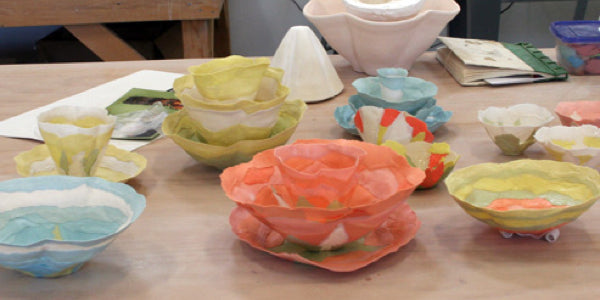
To tint the body itself, they can be wedged into clay or stirred into a casting slip or engobe. In general, using a white clay body will provide the most vibrant color results.While many of these stains can be fired to anywhere from cone 05 to cone 10 temperatures**, they are formulated specifically for use in oxidizing atmospheres.Results in a reduction atmosphere can differ. The percentage of stain needed will vary depending on your desired color intensity, so tests should be done to discover which percentages provide the desired results. That said, a good starting range is 10% to 20% stain to clay. This means that to add a 10% stain, one would use 10 grams of stain for every 100 grams of clay. For darker colors like blacks, blues, and greens, a smaller percentage of stain will be needed than for lighter colors like pinks and yellows. Likewise, when mixing your own colors, stronger colors may overpower the weaker ones if mixed in equal ratios.**Each Mason Stain® has its own set of firing instructions, not all colors will survive high fire conditions. Likewise, some colors will not mature fully at low fire temperatures. Always check thespecson the specific stain you are using, and when in doubt test, test, test!
- Heading
- Heading
- Heading
Mason Stains® can be mixed into a white glaze for opaque color or into a clear glaze for translucent “celadon-esque” appearances. Intensity of the color is determined by the percentage of stain added to the glaze. Generally, we recommend a starting point of 20-25%. We even weigh the bags out in 1/4# amounts, so you can start off by mixing one bag into one pint of glaze and then “season to taste”
Similarly, Mason stains can be mixed into underglazes or engobes for decoration purposes too!
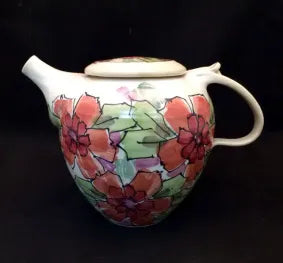
You can even mix the stains with water and decorate on top of a glaze for beautiful brushed-on decoration and majolica techniques. (Please note that at low temperatures, the stain needs to be mixed with a flux. We suggest equal parts stain, Frit 3124 and Gerstley Borate)
You can also use stains mixed with water directly on bisqueware and then cover with a clear glaze.
image: Tracy Townsley – Mason Stains® mixed with water, applied over a white glaze and fired to cone 5
- Heading
- Heading
- Heading
Extra Tips and Tricks
- When adding stains to a moist or liquid base such as moist clay, glaze, or slip, try mixing the stain first with a little bit of water (to a consistency of latex paint or slightly thicker) to make it easier to blend with the base.
- Heavy-duty (or freezer style) zip-close plastic baggies are particularly useful when adding stain to a clay body in small amounts to reduce mess and wasted stain. Just close the bag securely and knead the stain into the clay until well mixed. You can also make thin slabs of clay and apply a layer of the stain-and-water mixture between each slab, then knead/wedge together.