
L&L VentSure

Proper kiln ventilation removes harmful fumes and moisture at the source, minimizing the amount entering your environment, improving firing uniformity, and extending the life of your kiln components.
WHY VENTILATE YOUR KILN?
Proper ventilation is essential for safe and efficient kiln operation.
- You need to vent fumes from the kiln and heat from the room.
- Ceramic firing processes emit toxic fumes, such as carbon monoxide, heavy metal vapors, and volatile organic compounds, which can cause respiratory problems, irritation, or, at high levels, be fatal. These fumes are also corrosive, damaging the kiln and its surroundings over time.
- Excess heat buildup in enclosed spaces can present a fire hazard.
- Ventilation removes harmful fumes and excess heat, protecting users, reducing fire risks, extending kiln lifespan, and helping maintain consistent firing results. It also supports compliance with local regulations and safety standards.
- This guide explains effective methods for ventilating your kiln and kiln room.
VENTILATING THE KILN ROOM
Effective room ventilation manages ambient heat and prevents harmful fumes from building up in your environment.
Key Guidelines:
- Remove Heat: You can remove heat using fan ventilation or an HVAC system (heat pump or air conditioner).
- Exhaust Fans: We suggest using variable-speed fans to control airflow based on kiln operation and room conditions for fan ventilation.
- Air Exchange: Ensure fresh air can enter the room to replace exhausted air, preventing negative pressure.
- Temperature Monitoring: Install a thermometer to monitor heat levels and adjust ventilation as needed.
- Exhaust Placement: Position exhaust outlets away from windows and air intakes to prevent re-entry of fumes.
- Ventilation Rate: The ideal ventilation rate will vary depending on the room's size, kiln BTUs, and sprinkler systems. The BTUs can be found on the kiln's General Dimension drawing on our website. Consult an HVAC professional for your specific needs.
Downdraft Vent Systems
How Downdraft Vent Systems work:
A downdraft vent system is the most effective method of kiln ventilation. Connected directly to the underside of the kiln, these systems draw air through small holes in the kiln base, creating slight negative pressure in the kiln chamber, drawing fumes and moisture out, and improving heat distribution.
Benefits:
- Fume Extraction: Efficiently removes all harmful gases from the kiln chamber and directly exhausts them outside.
- Firing Uniformity: Promotes even heat distribution by counteracting the natural upward rise of hot air.
- Enhanced Atmosphere: Maintains an oxygen-rich environment, improving glaze results and extending element life.
Vent-Sure Downdraft Vent System
The Vent-Sure Downdraft Vent System offers efficient ventilation for L&L kilns. It effectively removes fumes and heat and is easy to install and listed to UL499 and Candian Standards. Accessories, including a vent control that plugs into your kiln control and vent doublers, are also available to enhance performance and save money.
VENT CONTROL:
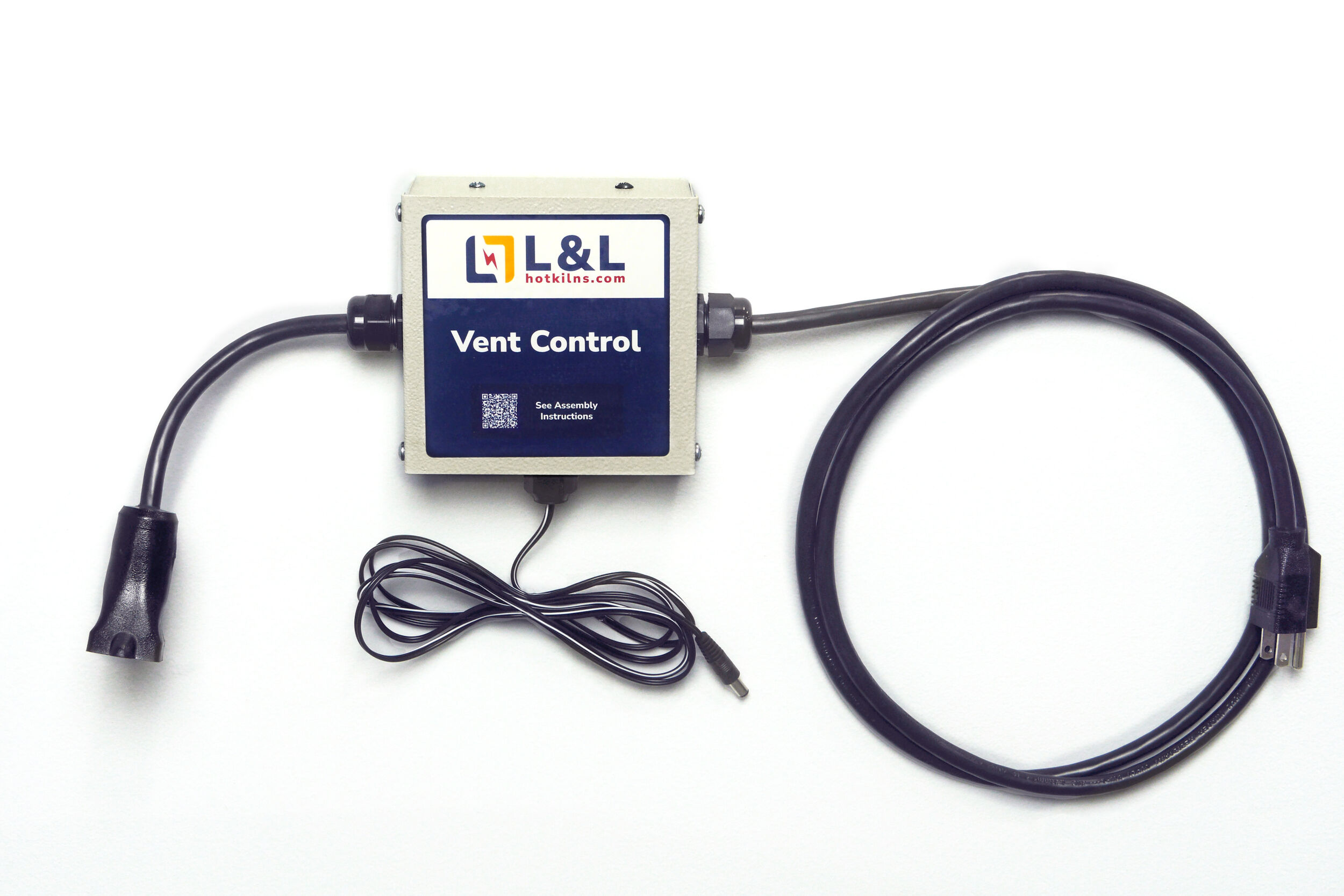
The Vent Control allows you to automatically control the operation of the Vent-Sure kiln vent with one of the outputs from the DynaTrol (or Genesis).
For more information see: hotkilns.com/vent-control
Construction
The Vent Control consists of a relay that is controlled from output #4 on the DynaTrol (or Genesis). There is a female 120 volt receptacle to plug the vent into and a cord to plug into a 120 volt wall outlet. There is a 6 foot wire that connects the control box to the kiln control panel. A grommet is included for non-factory installation. Where It Can Be Used It is only available for kilns with DynaTrols and Genesis controls. It may not be used with kilns with powered bottoms (because the same output on the control is used)
Operation
NOTE: These options are set in the “Hidden Menu” of the DynaTrol. (See hotkilns.com/hidden-menu for how to get into the hidden menu on the DynaTrol). On the Genesis control go to “4-Configuration” on the Main Menu and then to “6-Output 4 Options”. The code to get into Factory Configuration, if prompted, is 443.
OPTION A (OP A)
Used to control a vent. Output 4 can be programmed to be on or off during each segment of a Vary-Fire program. During an Easy-Fire program, output 4 comes on at the beginning of the firing and turns off after the kiln has cooled to 150F.
OPTION B (OP B)
Used to control a vent. Output 4 can be programmed to be on or off during each segment of a Vary-Fire program. Output 4 comes on at the beginning of an Easy-Fire program, off at 1450°F, back on after the firing is complete and the kiln has cooled to 1000°F and finally off again when the temperature is below 150°F.
OPTION C (OP C)
Used to control a vent, an alarm, or other atmospheric control. Output 4 can be programmed to be on or off during each segment of a Vary-Fire program. Output 4 is off during Easy-Fire programs